

Let us know more about your company
Oops! Something went wrong while submitting the form.

For large outbound reactivation campaigns, AI voice agents can contact more users simultaneously, launch without recruiting additional agents, follow the same approved conversation logic, and connect calls directly to messaging and conversion tracking.
A call center has an advantage when the conversation requires judgement, negotiation, relationship management, or a human account owner.
The cost models are also different. A call center combines staffing, management, training, telephony, and idle capacity. AI voice shifts more of the cost toward campaign execution and the number of users processed rather than agent hours.
An AI voice agent is software that can make or receive voice calls and conduct a conversation based on predefined business rules, user data, and real-time responses.
In an outbound reactivation campaign, the agent can:
The important distinction is between an AI voice agent and a recorded robocall.
A robocall plays a fixed message.
An AI voice agent listens to the response and continues the conversation based on what the user says.
{{table}}
[[]] [[AI Voice]] [[Call Center]]
[Campaign launch] [Can be configured and launched without hiring a new calling team] [Requires available agents, training, scripts, schedules, and management]
[Concurrent calls] [Multiple calls can run at the same time] [Limited by the number of available agents]
[Scaling a larger list] [Capacity can expand without adding an equivalent number of callers] [Usually requires more agent hours or additional staff]
[Conversation consistency] [Uses the same approved business and conversation logic] [Varies between agents and shifts]
[Language coverage] [Separate native-language voice setups can run by GEO] [Requires suitable language coverage within the team]
[Follow-up] [Call outcomes can trigger messaging flows directly] [Often requires separate CRM or agent actions]
{{endtable}}
Neither model is automatically better for every segment.
The useful question is:
What kind of conversation does this audience actually require?
Comparing AI calling cost with call-center cost on a per-minute basis misses most of the economics.
A call center has costs before the user even answers:
The cost also changes when campaign volume changes.
If a database grows from 10,000 to 50,000 users, a human operation needs enough available agent capacity to work through that list within the required window.
An AI outbound calling flow scales differently. The infrastructure handles call execution while people remain responsible for campaign logic, offer approval, QA, and optimization.
Bswan prices campaign execution from $0.34 per processed lead.
That is deliberately expressed per lead rather than per call because one user may require an initial call, another attempt after no answer, a messaging follow-up, routing, and tracking through to the final campaign outcome.
For a reactivation team, the more useful question is not:
What did one phone call cost?
It is:
What did it cost to work the segment, and what value came back from it?
Reactivation value changes with time.
A user who became inactive yesterday is not the same as someone who has been inactive for six months.
The first user still has recent context:
The longer the delay, the more context disappears.
This creates a capacity problem for human outbound teams. When a large segment becomes eligible at once, every contact competes for available agent hours.
With outbound AI calls, multiple conversations can happen in parallel. The segment does not need to wait in a calling queue until another agent becomes free.
That makes AI voice particularly relevant for:
If 20,000 users need the same type of conversation, assigning one human agent to each call creates an operational bottleneck.
AI voice can run the approved flow across the segment while still personalising selected fields such as name, language, offer, or previous activity.
A segment can be contacted when the trigger occurs rather than when enough call-center capacity becomes available.
This matters for fresh churn reactivation, where a delay of days or weeks changes the quality of the audience.
Many calls revolve around the same questions:
These are defined conversation paths rather than complex negotiations.
Every user should hear the approved offer and conditions.
An AI voice agent follows the same approved logic across the campaign instead of relying on different explanations from different agents.
A conversation can end with a defined status:
Those results can then determine what happens next.
AI voice is not the right answer for every outbound call.
Human agents remain useful when the conversation depends heavily on judgement or an existing relationship.
Examples include:
The useful model can therefore be hybrid.
AI voice handles the broad segment and standard conversation paths. Specific users or outcomes can move to a human agent when the conversation requires it.
That keeps human time focused on interactions where judgement and relationship management matter.
Using an AI calling platform does not automatically create a working reactivation campaign.
The phone call is one part of the flow.
A complete campaign still needs:
Consider a user who says:
“Yes, send me the offer.”
The conversation worked.
But conversion can still fail if the follow-up arrives late, the link opens the wrong page, or the user has to search for the offer.
That is why Bswan runs AI voice and messaging as one conversion flow rather than treating the AI call as a standalone product.
The operator controls the audience, offer, and business rules. Bswan manages outbound execution, follow-up logic, infrastructure, QA, tracking, and optimization.
The value of an AI voice reactivation campaign should be measured against the starting segment, not against call-center activity metrics alone.
In one tracked campaign, the starting conversion rate was 2.47%.
After the activation and outreach flow, conversion reached 5.38%.
That is a 2.91 percentage-point increase from the same underlying audience.
The useful comparison is not:
AI made more calls than people.
It is:
Did reaching the segment differently produce more completed actions from the same database?
Call volume, answer rate, and conversation duration help diagnose the campaign. Conversion and generated value show whether the outreach changed the result.
Start with the segment rather than the technology.
Use AI outbound calls when:
Use a human call center or account-management flow when:
For many businesses, the choice is not AI voice or a call center.
It is deciding which conversations should still consume human time.
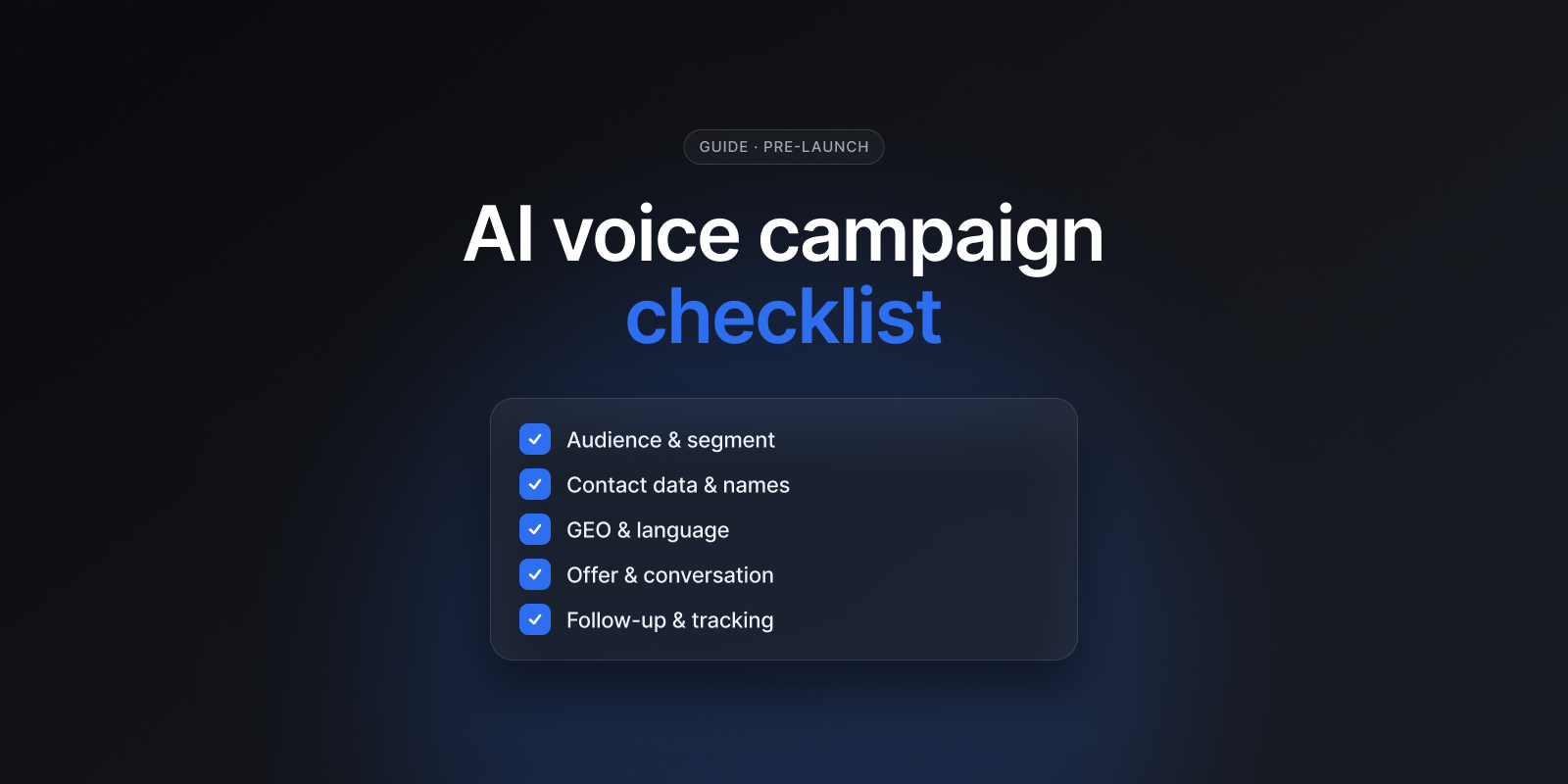
Start with the action the user should complete after the call.
Examples include:
“Improve engagement” is not a campaign action. It is too broad to guide the conversation, follow-up, or tracking.
A clear action answers three questions:
The campaign should have one primary conversion goal. Secondary outcomes can still be recorded, but the call should not ask the user to complete several unrelated actions.
A contact list is not always one audience.
New registrations, old leads, failed payments, inactive customers, and previous buyers may all exist in the same database. They should not receive the same call.
Each audience has a different context:
Mixing several use cases creates a script that needs to explain everything and fits no one.
A practical rule:
If two users need a different reason for the call, they belong in different campaigns.
Two users can speak the same language and still need different campaign setups.
GEO affects more than translation. It can change:
A campaign for Portugal should not use the same voice, wording, offer, and conversion path as a campaign for Brazil, only because both audiences speak Portuguese.
An AI agent can only use the information it receives.
A list may look complete while still containing problems that break personalisation or send the wrong user into the campaign:
These issues should be fixed before the contact list enters the calling flow.
Name quality deserves a separate check because it affects the opening seconds of the conversation.
Bad examples include:
The name may look acceptable in a spreadsheet, but sound wrong when spoken aloud.
For multilingual campaigns, pronunciation also depends on the alphabet, language variant, and voice used in the campaign.
The offer should be clear after one or two sentences.
If it requires a long internal explanation, the user will struggle to understand it during a call.
A clear offer answers:
The call, follow-up message, landing page, and product should describe the same offer.
A call should not promise one thing while the link opens a page with different wording or conditions.
A written script can look correct and still fail in a real conversation.
Users interrupt. They answer with one word. They ask unrelated questions. They misunderstand the offer. They request another call. They say they are not interested and then explain the actual problem.
The campaign needs conversation logic, not only approved copy.
Test:
The agent should also know when to stop. Repeating the same question after a clear refusal damages the conversation.
Not every contact should receive the same message after the call.
The follow-up should depend on what happened:
A generic SMS sent after every call ignores the context of the conversation.
The sequence also needs a stop condition. Once the user converts, opts out, or becomes ineligible, the campaign should stop contacting them.
A user saying “yes” during the call does not mean the campaign has converted them.
The next step may still fail because:
Open the full journey as a user would experience it.
Start with the message or link sent after the conversation and complete the action on both desktop and mobile. Check every page, field, redirect, login step, and confirmation.
The user should arrive directly at the action discussed during the call.
A user should not have to search for what the call just promised.
The campaign needs enough user context to run the right conversation and a reliable way to return the result.
Before launch, confirm which data is passed into the campaign:
The data also needs to move in the other direction.
Call outcomes, callback requests, opt-outs, and completed actions should return to the CRM or internal analytics system and remain connected to the same user ID.
Without this feedback loop, converted users may stay in the sequence, opt-outs may receive another message, and the company may not be able to connect outreach to the final result.
The internal report should connect the original audience, conversation outcomes, completed actions, and generated value. Answer rate and call duration show whether communication happened, but not whether the campaign changed the result.
Do not start with the full database.
A small test segment can reveal:
The test should contain enough contacts to produce real conversations, not only internal calls between colleagues.
Review recordings, outcomes, user journeys, and completed actions before scaling.
The client should not need to build or supervise every technical layer of an AI voice campaign.
Before launch, define which parts are handled by the campaign provider and which remain with the internal team.
Bswan manages the execution layer, including:
The client provides:
The split should be clear before implementation begins.
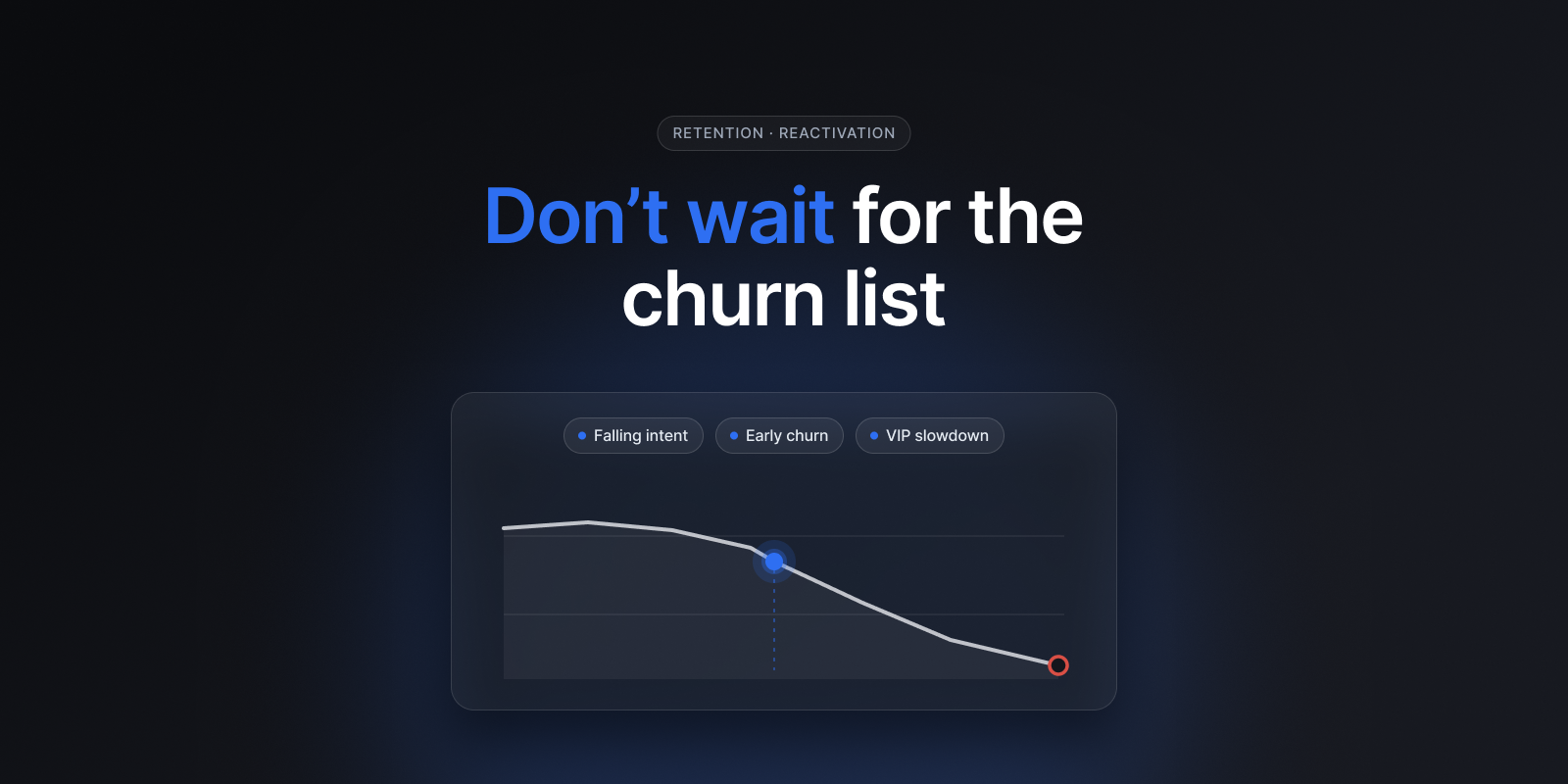
Behavior-triggered player reactivation starts outreach when a player’s behavior signals a time-sensitive churn risk instead of waiting for the player to appear on a scheduled inactivity list.
The trigger may be an active player entering early churn, a depositing player increasing the gaps between sessions, or a VIP whose deposits and activity have started to decline.
A similar trigger-based approach can also support registration activation when a registered non-depositor begins losing intent. However, that segment should be treated separately: a non-depositor needs activation toward a first deposit, while an existing depositor needs retention or reactivation.
Modern predictive systems can identify churn risk much earlier than traditional 30-, 60-, or 90-day inactivity lists. Some AI churn models can flag at-risk players from the first day of inactivity and continuously update their predictions using live operator data. The operational question is what happens after that signal appears.
A list-based reactivation process starts with a fixed rule:
The operator then sends a campaign to the entire segment.
This process is simple to manage and easy to report on. It remains useful for large, lower-priority reactivation segments where timing is less sensitive.
The limitation is that the list records a state after it has already happened. It tells the operator that the player is inactive, but it may not capture the earlier moment when the player first began changing behavior.
Moment-based reactivation reverses the sequence.
Instead of waiting for a churn list to fill, the system watches for a specific behavioral signal and starts an outreach flow while the player is still close to their previous level of activity.
The difference is not simply real-time versus monthly automation. It is the difference between acting on an early signal and acting on a completed outcome.
A user registers but does not complete a first deposit.
During the first days and weeks after sign-up, the user may still remember the original offer, the affiliate source, and the reason they created the account. As that context fades, the registration becomes harder to convert.
This is a registration activation use case rather than player reactivation.
The relevant signals may include:
Waiting until the user becomes an old non-depositor means acting after the highest-intent window has already narrowed.
A depositing player rarely moves from active to fully churned in one visible step.
The change often appears through a combination of signals:
This is one of the highest-leverage moments in the player lifecycle because the relationship has weakened but has not disappeared.
Behavioral models can help identify this risk before full inactivity. In its reporting on AI and personalisation in iGaming, iGaming Business noted that predictive behavioral models can identify players likely to churn weeks before they leave, giving CRM teams time to respond with more personalised retention activity.
A VIP slowdown can have a disproportionate effect on revenue even when the number of affected players is small.
The signal may not look like complete inactivity. A high-value player may still log in and deposit, but at a lower frequency or value than their normal pattern.
That makes generic churn thresholds less useful.
A VIP who previously deposited several times per week may need attention after a short change in behavior. Applying the same inactivity rule used for a low-value or occasional player can surface the problem too late.
This is why VIP retention, high-value player monitoring, and VIP churn prediction need separate logic from broad player reactivation.
Many operators already have access to segmentation, real-time events, predictive churn models, or player scoring.
The gap often appears between detection and execution.
A CRM may identify an at-risk player immediately, but the next action may still be:
In that situation, the risk signal exists, but the response still follows list-based timing.
Early detection can combine several behavioral models, continuous training on live operator data, and recommendations on re-engagement timing and incentives. The value of that signal depends on whether the operator can connect it to an executable outreach flow while the signal is still relevant.
The CRM identifies the moment. The activation and reactivation infrastructure determines what happens next.
A static churn list needs a segment definition and a scheduled campaign.
A behavior-triggered reactivation workflow needs several connected components.
The operator must define what the signal means for each segment.
For example:
A trigger should reflect the player’s previous behavior and value, not only a universal inactivity threshold.
The detection loop must identify the signal while it is still actionable.
This may involve:
The required speed depends on the segment. A VIP slowdown may require a faster response than a broad low-value churn segment.
The trigger must connect to a clear next action.
That action may include:
The workflow also needs retry rules, delivery routing, tracking, suppression logic, and a clear stop condition.
Without this execution layer, early churn detection becomes another dashboard signal that someone may review later.
VIP behavior should be measured against the player’s own history and commercial value.
A general churn model may ask whether a player has been inactive for a fixed number of days. A VIP retention model needs more context:
A VIP may still appear active while already generating less value than usual. That is why a slowdown should be measured against the player’s normal pattern, not only against a fixed inactivity threshold.
The outreach logic should also be different. A high-value player may require a faster response, a more relevant offer, or direct contact instead of the same automated message sent to a broader churn segment.
VIP slowdown should therefore remain separate from generic reactivation logic used across the rest of the database.
iGaming CRM is moving beyond reliance on static segments and scheduled batch campaigns.
More operators are building retention and reactivation workflows around:
This does not mean every operator already runs a fully connected real-time reactivation system.
Detection is becoming faster and more precise, but the main operational challenge remains the same: connecting the signal to the right outreach channel, offer logic, follow-up sequence, and measurable conversion flow.
A churn prediction only identifies the risk. The commercial result depends on what happens next.
A behavioral signal only creates value if the player receives an outreach experience capable of changing the outcome.
Static communication remains useful for reminders, offers, and broad CRM coverage. Its limitation appears when the player has a question or objection that the message cannot anticipate.
An SMS can remind the player that an offer exists, but it cannot discover that:
A conversational channel can respond to the player in real time.
That may be a human agent, an account manager, or an AI voice agent connected to messaging and campaign logic.
The value comes from the ability to listen, respond, clarify, and direct the player toward the next action. In an AI voice reactivation workflow, that conversation can also be connected to follow-up messages, retry logic, routing, and conversion tracking.
This makes conversational outreach more suitable for time-sensitive activation and reactivation moments than another standalone message added to the same CRM sequence.
Behavior-triggered engagement does not replace the operator’s CRM, email platform, SMS provider, internal retention team, or predictive model.
It connects detection to execution.
The operator continues to control:
The execution layer manages what happens after the trigger:
This creates a detection-to-outreach workflow rather than a disconnected sequence of CRM alerts, manually pulled segments, and separate communication tools.
The role of the CRM is to identify who requires attention and when. The role of the activation infrastructure is to turn that signal into a managed, measurable player interaction.
Moment-based triggers create the most value when the cost of waiting is high.
Use a trigger-based activation flow when:
Use behavior-triggered reactivation when:
Use separate VIP logic when:
List-based reactivation still has a role for large, lower-priority segments where a weekly or monthly campaign is commercially sufficient.
The two approaches solve different problems.
A churn list tells the operator who has already become inactive. A behavioral trigger identifies the moment when the operator may still prevent that outcome.
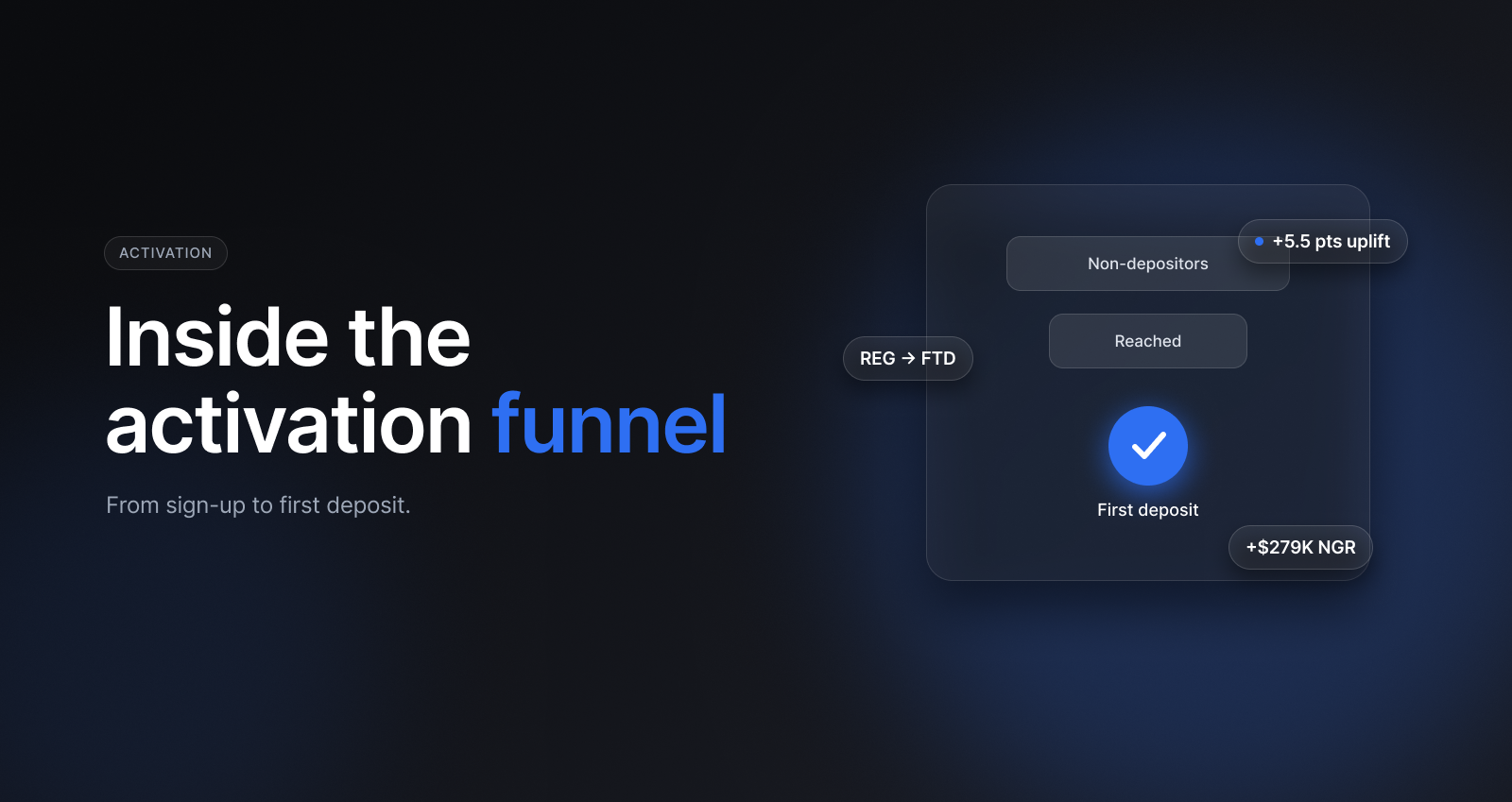
An activation funnel is a managed, tracked conversion flow designed to move registered non-depositors toward a first deposit. It combines AI voice calls, SMS follow-ups, delivery routing, campaign logic, and deposit tracking in one connected sequence.
In one tracked campaign in Portugal, the funnel increased first-deposit conversion from 19% to 24.5% in 30 days. That 5.5-point conversion lift added 582 first-time depositors and generated $279,000 in additional NGR, without increasing acquisition spend.
A non-depositor and a churned player may both appear inactive in a CRM, but they represent two different stages of the player lifecycle.
A non-depositor registered but never completed a first deposit.
A churned player deposited at least once and later became inactive.
The activation campaign covered in this article targeted non-depositors who had passed 31 days since registration without depositing.
Correct segment naming matters because each audience requires different campaign logic. Registered non-depositors may still need help understanding the offer, payment process, verification requirements, or the next step after sign-up. Churned players already understand the product and need a different reason to return.
Combining these segments under one label distorts:
An activation funnel is more than an automated call followed by a message. It is a managed conversion sequence in which AI voice, messaging, routing, tracking, and follow-up logic work together.
For this campaign, the user activation funnel included four main stages.
The first touch is an AI voice call made in the player’s language.
Unlike a static email, banner, or SMS, a voice conversation can respond to what the player says. The AI voice agent can clarify the offer, answer common questions, identify hesitation, and adapt the next part of the conversation based on the response.
This makes AI voice especially useful for registered non-depositors who have already received standard CRM communication but still have not completed a first deposit.
Players who do not answer the call, ask for more information, or need time to complete the next step receive an SMS follow-up.
The message is connected to the same campaign rather than sent as an isolated CRM touch. Delivery routes are selected and monitored for performance and deliverability, while the message reflects the offer and context of the activation campaign.
A final SMS touch gives the player another opportunity to return while the offer or campaign event is still relevant.
The timing, content, and delivery logic depend on the segment and offer. This final contact completes the planned outreach sequence without turning the campaign into an unlimited series of disconnected reminders.
Calls, messages, clicks, and resulting deposits are tracked within one activation flow.
Campaign performance is measured through:
This gives the operator visibility into both communication performance and the commercial result generated by the segment.
The result is a measurable registration activation funnel, rather than a set of separate communication tools with no shared reporting.
The operator remains in control of the commercial inputs.
Before the activation campaign launches, the client reviews and approves:
Nothing is launched before the campaign content and settings are approved.
Bswan then manages the conversion infrastructure around the campaign, including AI voice execution, messaging delivery, routing, tracking, call QA, and ongoing optimization.
This allows the activation funnel to run as an extension of the existing CRM and retention operation rather than replacing the operator’s current systems.
Launch time depends on the campaign scope, integration requirements, segment, and offer.
For pre-packaged, event-driven activation funnels, a campaign can go live within 72 hours after Bswan receives the player list, approved offer, and required campaign inputs.
More complex launches may also include CRM or FMS integration, custom business logic, private deployment, or additional compliance requirements.
{{table}}
[[Metric]] [[Result]]
[Segment] [Non-depositors, 31+ days since registration]
[GEO] [Portugal]
[Baseline first-deposit conversion] [19%]
[Post-campaign conversion] [24.5%]
[Conversion lift] [+5.5 percentage points]
[Campaign window] [30 days]
[Additional first-time depositors] [+582]
[Additional NGR] [+$279,000]
[Average NGR per additional depositor] [~$480]
{{endtable}}
The campaign did not depend on new traffic or a larger acquisition budget.
The entire uplift came from registered users who already existed in the operator’s database but had not completed a first deposit.
That is the main purpose of an activation funnel: to generate more value from existing registrations before the operator pays to acquire more traffic.
First-deposit conversion rates should always be read in the context of the segment.
A fresh registration segment, a 31-day non-depositor segment, and an older cold database will not have the same baseline or produce the same conversion lift.
Campaign performance depends on factors such as:
This is why a conversion uplift should not be evaluated as an isolated percentage.
In the Portugal campaign, the starting first-deposit conversion was already 19%. The activation funnel added another 5.5 percentage points, moving the total conversion rate to 24.5%.
That means the campaign improved an existing registration-to-deposit funnel rather than creating conversion from a completely cold database.
Results also vary between campaigns. The 5.5-point lift reflects one tracked Portugal campaign and should not be treated as a universal benchmark for every GEO or player segment.
Email and SMS remain important parts of the CRM lifecycle. They are efficient, scalable, and already familiar to players.
The limitation is that static communication cannot react to an individual response.
An SMS can remind a player about an offer, but it cannot discover that the player has a payment question. An email can explain bonus terms, but it cannot adjust the explanation when the player misunderstands one condition. A push notification can bring the user back to the site, but it cannot identify what stopped the deposit the first time.
An AI voice call creates a real-time interaction inside the activation funnel.
The follow-up messages then support that conversation by giving the player a direct path back to the offer, payment page, or next required action.
Voice and messaging are therefore most effective when used together as one tracked sequence.
An activation funnel does not replace the operator’s CRM, email platform, SMS provider, or internal retention team.
It adds a managed conversion layer for segments that need more than standard automated messaging.
The operator continues to control:
Bswan manages the communication and conversion infrastructure required to run the campaign across AI voice and messaging channels, track player responses, and connect results back to first deposits and NGR.
This makes the system an additional activation tool inside the existing player lifecycle rather than a separate replacement for the CRM stack.
A registration activation funnel is most relevant when an operator has a meaningful volume of registered non-depositors and wants to improve first-deposit conversion without increasing acquisition spend.
Common use cases include:
The best results usually come from clearly defined segments with a specific offer and a measurable conversion goal.
