

Let us know more about your company
Oops! Something went wrong while submitting the form.
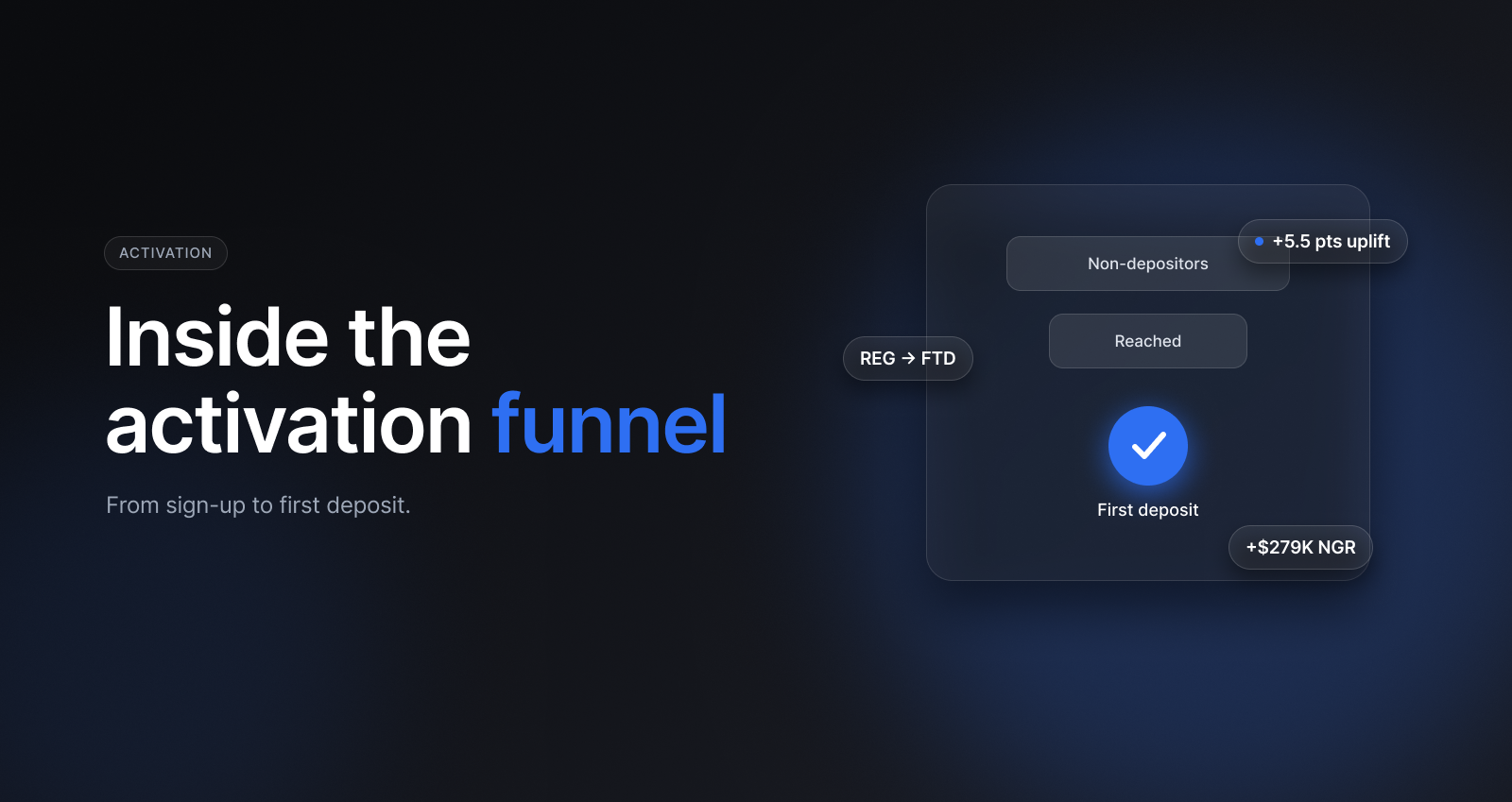
An activation funnel is a managed, tracked conversion flow designed to move registered non-depositors toward a first deposit. It combines AI voice calls, SMS follow-ups, delivery routing, campaign logic, and deposit tracking in one connected sequence.
In one tracked campaign in Portugal, the funnel increased first-deposit conversion from 19% to 24.5% in 30 days. That 5.5-point conversion lift added 582 first-time depositors and generated $279,000 in additional NGR, without increasing acquisition spend.
A non-depositor and a churned player may both appear inactive in a CRM, but they represent two different stages of the player lifecycle.
A non-depositor registered but never completed a first deposit.
A churned player deposited at least once and later became inactive.
The activation campaign covered in this article targeted non-depositors who had passed 31 days since registration without depositing.
Correct segment naming matters because each audience requires different campaign logic. Registered non-depositors may still need help understanding the offer, payment process, verification requirements, or the next step after sign-up. Churned players already understand the product and need a different reason to return.
Combining these segments under one label distorts:
An activation funnel is more than an automated call followed by a message. It is a managed conversion sequence in which AI voice, messaging, routing, tracking, and follow-up logic work together.
For this campaign, the user activation funnel included four main stages.
The first touch is an AI voice call made in the player’s language.
Unlike a static email, banner, or SMS, a voice conversation can respond to what the player says. The AI voice agent can clarify the offer, answer common questions, identify hesitation, and adapt the next part of the conversation based on the response.
This makes AI voice especially useful for registered non-depositors who have already received standard CRM communication but still have not completed a first deposit.
Players who do not answer the call, ask for more information, or need time to complete the next step receive an SMS follow-up.
The message is connected to the same campaign rather than sent as an isolated CRM touch. Delivery routes are selected and monitored for performance and deliverability, while the message reflects the offer and context of the activation campaign.
A final SMS touch gives the player another opportunity to return while the offer or campaign event is still relevant.
The timing, content, and delivery logic depend on the segment and offer. This final contact completes the planned outreach sequence without turning the campaign into an unlimited series of disconnected reminders.
Calls, messages, clicks, and resulting deposits are tracked within one activation flow.
Campaign performance is measured through:
This gives the operator visibility into both communication performance and the commercial result generated by the segment.
The result is a measurable registration activation funnel, rather than a set of separate communication tools with no shared reporting.
The operator remains in control of the commercial inputs.
Before the activation campaign launches, the client reviews and approves:
Nothing is launched before the campaign content and settings are approved.
Bswan then manages the conversion infrastructure around the campaign, including AI voice execution, messaging delivery, routing, tracking, call QA, and ongoing optimization.
This allows the activation funnel to run as an extension of the existing CRM and retention operation rather than replacing the operator’s current systems.
Launch time depends on the campaign scope, integration requirements, segment, and offer.
For pre-packaged, event-driven activation funnels, a campaign can go live within 72 hours after Bswan receives the player list, approved offer, and required campaign inputs.
More complex launches may also include CRM or FMS integration, custom business logic, private deployment, or additional compliance requirements.
{{table}}
[[Metric]] [[Result]]
[Segment] [Non-depositors, 31+ days since registration]
[GEO] [Portugal]
[Baseline first-deposit conversion] [19%]
[Post-campaign conversion] [24.5%]
[Conversion lift] [+5.5 percentage points]
[Campaign window] [30 days]
[Additional first-time depositors] [+582]
[Additional NGR] [+$279,000]
[Average NGR per additional depositor] [~$480]
{{endtable}}
The campaign did not depend on new traffic or a larger acquisition budget.
The entire uplift came from registered users who already existed in the operator’s database but had not completed a first deposit.
That is the main purpose of an activation funnel: to generate more value from existing registrations before the operator pays to acquire more traffic.
First-deposit conversion rates should always be read in the context of the segment.
A fresh registration segment, a 31-day non-depositor segment, and an older cold database will not have the same baseline or produce the same conversion lift.
Campaign performance depends on factors such as:
This is why a conversion uplift should not be evaluated as an isolated percentage.
In the Portugal campaign, the starting first-deposit conversion was already 19%. The activation funnel added another 5.5 percentage points, moving the total conversion rate to 24.5%.
That means the campaign improved an existing registration-to-deposit funnel rather than creating conversion from a completely cold database.
Results also vary between campaigns. The 5.5-point lift reflects one tracked Portugal campaign and should not be treated as a universal benchmark for every GEO or player segment.
Email and SMS remain important parts of the CRM lifecycle. They are efficient, scalable, and already familiar to players.
The limitation is that static communication cannot react to an individual response.
An SMS can remind a player about an offer, but it cannot discover that the player has a payment question. An email can explain bonus terms, but it cannot adjust the explanation when the player misunderstands one condition. A push notification can bring the user back to the site, but it cannot identify what stopped the deposit the first time.
An AI voice call creates a real-time interaction inside the activation funnel.
The follow-up messages then support that conversation by giving the player a direct path back to the offer, payment page, or next required action.
Voice and messaging are therefore most effective when used together as one tracked sequence.
An activation funnel does not replace the operator’s CRM, email platform, SMS provider, or internal retention team.
It adds a managed conversion layer for segments that need more than standard automated messaging.
The operator continues to control:
Bswan manages the communication and conversion infrastructure required to run the campaign across AI voice and messaging channels, track player responses, and connect results back to first deposits and NGR.
This makes the system an additional activation tool inside the existing player lifecycle rather than a separate replacement for the CRM stack.
A registration activation funnel is most relevant when an operator has a meaningful volume of registered non-depositors and wants to improve first-deposit conversion without increasing acquisition spend.
Common use cases include:
The best results usually come from clearly defined segments with a specific offer and a measurable conversion goal.

Predictive player retention uses behavioral data to identify players whose activity is beginning to decline before they become fully inactive.
Instead of waiting for a completed churn event, the operator watches for changes such as:
These changes can move a player into an early churn segment and trigger a retention workflow while the relationship is still active.
Current churn models can evaluate risk from the first day of inactivity and continuously update predictions using recent operator data. The commercial value begins when that signal is connected to timely outreach.
A traditional reactivation campaign starts with a completed condition:
Everyone inactive for 30 days.
That rule is useful for identifying dormant players, but it does not show when the decline began.
Consider two players on the same 30-day inactivity list:
They have reached the same list, but the signal means something different.
For the first player, 30 days represents a major break from normal behavior. For the second, it may still fit the usual cycle.
A static churn list measures time since the last action. Behavioral churn detection measures the change from the player’s own baseline.
That change is the early warning.
No single signal proves that a player is leaving. Churn risk becomes more useful when several changes appear together.
{{table}}
[[Signal]] [[What changed]]
[Session frequency] [Visits fall below the player’s normal pattern]
[Deposit cadence] [Gaps become longer or deposit values decline]
[Playtime] [Sessions become consistently shorter]
[Product engagement] [Activity drops across previously preferred products]
[CRM response] [Messages that previously produced action stop converting]
[Active days] [The number of playing days declines over time]
{{endtable}}
These signals show that behavior has changed. They do not explain the reason.
That distinction matters. A shorter session may indicate lower intent, a product issue, payment friction, or something unrelated to the operator. The signal identifies when outreach is needed; the conversation helps identify what changed.
Churn should be measured against the player’s own rhythm.
A player who deposits every Friday should not be evaluated in the same way as someone who deposits several times per day. A VIP slowdown should not use the same threshold as occasional low-value activity.
Useful trigger logic may account for:
This creates a more useful question than “How many days has the player been inactive?”
The question becomes:
Is this player behaving differently enough from their normal pattern to require action?
That reduces unnecessary outreach and helps retention teams focus on genuine churn risk signals.
Detection alone does not retain a player.
A risk score, dashboard alert, or segment change only identifies the problem. The operator still needs to decide:
A complete behavior-triggered retention workflow connects the signal to an executable sequence.
For example:
The predictive model or CRM determines when the player needs attention.
Bswan does not decide that a player is at risk. It takes the operator’s approved segment or trigger and runs the AI voice and messaging flow that follows.
A player showing early churn signals is different from someone who has been inactive for several months.
The fresh-churn player may still:
An older churn segment usually needs a stronger reason to re-engage and may contain more unreachable or permanently lost players.
This is why fresh churn targeting belongs closer to early retention than deep reactivation.
The goal is not only to recover players after they leave. It is to reduce the number who reach deep churn at all.
For operators, that changes the economics of retention:
Behavioral data can show that something changed. It cannot always explain why.
A player may be slowing down because:
A static message can present another offer. An AI voice retention call can ask a question, respond to the answer, clarify the next step, and connect the conversation to a messaging follow-up.
This makes AI voice useful as the execution layer after an early churn trigger.
A managed workflow can combine:
AI voice does not replace churn prediction or the operator’s CRM. It turns an early warning signal into a managed player conversation.
A predictive retention campaign should not be judged only by call volume, delivery rate, or clicks.
The core metrics should connect outreach to player value:
Control groups matter because some players would have returned without intervention. Comparing contacted and non-contacted players helps separate campaign uplift from natural behavior.
Retention teams should also compare different intervention windows:
That comparison shows how much value is lost by waiting.
Deep reactivation will remain part of the player lifecycle. Operators will always have dormant databases that justify scheduled win-back campaigns.
But a churn list should not be the first time the retention team notices that a valuable player is leaving.
The stronger model is:
That is the shift from reactive retention to predictive churn prevention.
The advantage is not the prediction itself. It is acting while the outcome can still change.
